
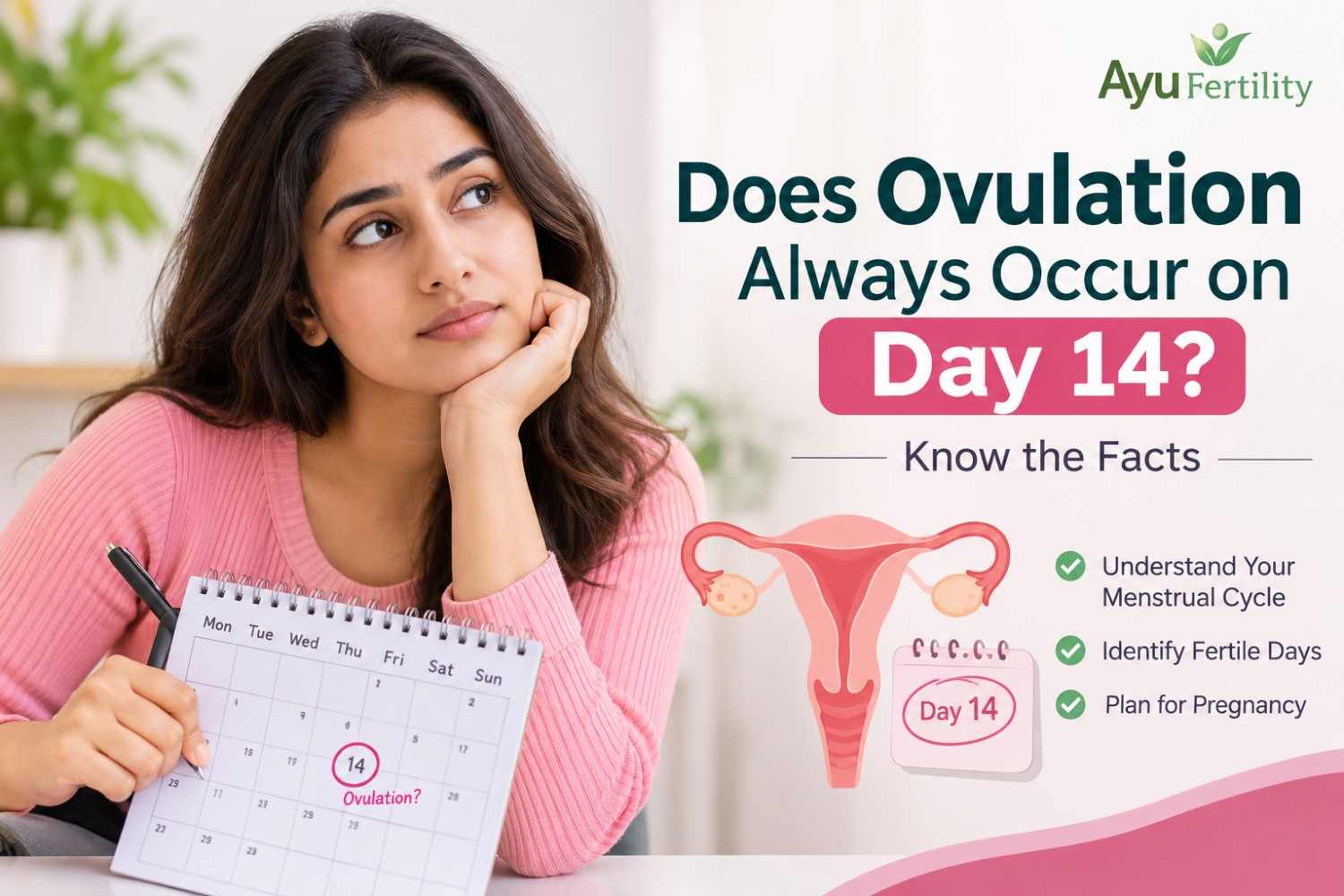
Many people believe ovulation happens on Day 14 of every menstrual cycle. While this is often used as an example for a 28-day cycle, it is not a universal rule. Menstrual cycles vary, and ovulation may occur earlier or later depending on cycle length, hormones, stress and other factors.
Understanding ovulation can help you recognise your fertile window and plan for pregnancy. At Ayu Fertility, menstrual patterns are considered individually rather than relying on a fixed calendar date.
Why Is Day 14 Commonly Associated with Ovulation?
Day 1 of the menstrual cycle is the first day of menstrual bleeding. In a typical 28-day cycle, ovulation may occur around Day 14. However, not everyone has a 28-day cycle, and even regular cycles may occasionally vary.
Ovulation generally occurs about 12–14 days before the next period, although this interval can vary. Someone with a shorter cycle may ovulate earlier, while someone with a longer cycle may ovulate later.
For example:
- In a 24-day cycle, ovulation may occur around Day 10.
- In a 28-day cycle, ovulation may occur around Day 14.
- In a 32-day cycle, ovulation may occur around Day 18.
These are estimates, not exact predictions. Ayu Fertility encourages people planning pregnancy to understand their own cycle instead of assuming ovulation always occurs on the same day.
What Factors Can Change Ovulation Timing?
Ovulation timing may shift due to several factors:
- Cycle length: Shorter or longer cycles can change the expected ovulation date.
- Stress: Physical or emotional stress may affect hormonal signals involved in ovulation.
- Illness or routine changes: Travel, disrupted sleep, illness or intense exercise may temporarily influence cycles.
- Hormonal conditions: PCOS or thyroid disorders may contribute to irregular ovulation.
- Body-weight changes: Significant weight changes may affect reproductive hormone balance.
If periods are frequently irregular or ovulation is difficult to predict, a healthcare professional can help assess possible causes. Ayu Fertility emphasises understanding the underlying reasons rather than relying only on cycle calculations.
How Can You Identify Your Fertile Window?
The fertile window usually includes the five days before ovulation and the day of ovulation. Sperm can survive for several days in the reproductive tract, while the egg remains fertilisable for a relatively short time after release.
1. Track menstrual cycles
Record the first day of each period and cycle length for several months. This may reveal patterns, but calendar tracking alone may not accurately predict ovulation, especially if cycles are irregular.
2. Observe cervical mucus
Near ovulation, cervical mucus may become clear, slippery and stretchy, similar to raw egg white. This can be a sign of increased fertility.
3. Use ovulation predictor kits
Urine tests detect a rise in luteinising hormone (LH), which usually occurs before ovulation. A positive result suggests ovulation may happen soon, but it does not confirm egg release.
4. Monitor basal body temperature
Basal body temperature may rise slightly after ovulation. Recording it each morning can help identify a pattern retrospectively, but it is less useful for predicting ovulation in the current cycle.
Ayu Fertility suggests discussing tracking methods with a qualified practitioner if cycle patterns are confusing or conception is taking longer than expected.
Can You Ovulate Without a 28-Day Cycle?
Yes. Ovulation can occur in shorter or longer cycles. A cycle does not have to follow the textbook 28-day pattern, although persistently very short, very long or unpredictable cycles may need evaluation.
Irregular periods may be associated with PCOS, thyroid conditions, changes in prolactin or other health factors. If you experience missed periods, unusually heavy bleeding, significant pelvic pain or repeated cycle irregularity, seek medical advice instead of relying only on home tracking.
When Should You Seek Fertility Guidance?
Consider consulting a fertility professional if:
- Your periods are frequently irregular or absent.
- You are unsure whether ovulation is occurring.
- You have concerns such as PCOS or endometriosis.
- You have been trying to conceive for 12 months if under 35, or for 6 months if 35 or older. Seek advice sooner if you have a known fertility concern or are over 40.
An evaluation may include menstrual history, appropriate hormone tests, ultrasound and assessment of both partners when indicated. Fertility is not only a female concern; sperm health can also influence conception.
For personalised support, Ayu Fertility provides information about Ayurvedic Female Infertility Treatment in Delhi and Ayurvedic Male Infertility Treatment in Delhi. Those unable to visit in person may also consider Ayurvedic Doctor Online Consultation to discuss concerns and understand possible next steps. Treatment decisions should follow an appropriate assessment and, where indicated, standard medical investigations.
Final Thoughts
Ovulation does not always occur on Day 14. Its timing depends on cycle length and individual patterns, so calendar estimates may not be reliable for everyone. Tracking periods, observing cervical mucus and using ovulation tests can offer clues, but persistent irregularity deserves professional attention.
At Ayu Fertility, the focus is on helping individuals and couples understand reproductive health and make informed pregnancy-planning decisions. Knowing your cycle is a useful starting point, and personalised guidance can help you understand it better.